Showing posts with label COVID-19. Show all posts

Friday, May 8, 2020

Social isolation on seniors

Understanding the Three Types Of Loneliness

By Rebecca Shapiro / May 4, 2020
(Reprinted from my Facebook page)

Gerontologist Linda P. Fried discusses the unique mental stress of social isolation on the elderly.


The COVID-19 pandemic has shut down society in an unprecedented way, but for the elderly, the consequences of both the disease and the social distancing required to curb its spread are sizable. 
Gerontologist Linda P. Fried, dean of the Mailman School of Public Health, explains that adults sixty-five and older are at higher risk for severe illness and death from the virus because of their “decreased reserves.” 
“There are changes in our physiology as we get older that make it harder for us to bounce back from any kind of illness. We call that frailty,” Fried says. “Older people are also more likely to have other long-term medical conditions. Because of that, the body is less able to handle a major stressor or infection.”
Such physiological vulnerability is exacerbated by the fact that nursing homes, assisted-living facilities, and hospitals have been breeding grounds for COVID-19. But Fried is also concerned about the well-being of seniors who live independently. 
Fried, whose research focuses on healthy aging, says that older adults benefit tremendously by staying both mentally and physically active. Now, as people are encouraged — and in many states legally required — to stay at home, Fried worries about further isolating this population. 
“As people get older, their life circumstances change. They lose their spouses to death or divorce, friends die, children move far away,” she says. “Obviously that now has bigger ramifications. There are deep mental tolls, and one of the most devastating is loneliness.”
Fried says that older adults are prone to three specific kinds of loneliness. The first is brought on by a lack of intergenerational contact. “We need all age groups to interact to create meaningful lives,” Fried says. Second, aging adults feel lonely when they aren’t able to contribute to society. While others might bond with colleagues or schoolmates as they work or attend class online, the elderly are not likely to have such outlets. And finally, aging adults are prone to what Fried calls an existential loneliness. 
“People are wondering if their lives are going to end shortly for reasons out of their control. They’re wondering if they’ll be able to get the care they need,” she says. “And most profoundly, they’re wondering if they are going to be cast out of society. If their lives have value.”
 The COVID-19 pandemic has brought that last question into startling reality as society has grappled with impossible dilemmas. In Italy, doctors working with limited resources were forced to prioritize the care of younger adults with a better chance of recovery. As the pandemic rages across the globe, other hospitals may be faced with the same impossible choices. In addition, decisions on how and when to relax social-distancing recommendations must factor in the value of society’s most vulnerable citizens. 
“The ferocity of this particular virus has caught a lot of us by surprise,” Fried says. “We have a lot more questions than answers for the future.” 

This article appears in the Spring/Summer 2020 print edition of Columbia Magazine as part of the cover story, "What We Have Learned From the Pandemic (So Far)."

Sunday, April 19, 2020

We are in the same storm

I saw this on a friend’s  Facebook page (author unknown) and thought it summed up the COVID-19 situation so perfectly. May we weather this storm together. So please be kind and know....

WE ARE NOT IN THE SAME BOAT

I heard it said that we are all in the same boat, but it's not like that. We are in the same storm, but not in the same boat. Your ship could be shipwrecked and mine might not be. Or vice versa.
For some, quarantine is optimal: a moment of reflection, of re-connection, easy in flip flops, with a cocktail or coffee. For others, this is a desperate financial & family crisis.
In some homes a sole occupant faces endless loneliness. In others, family members are getting peace, rest, and time with each other — while in still others, quarantine means an increased danger due to domestic violence.
With the $600 weekly increase in unemployment some are bringing in more money to their households than they were working. Others are working more hours for less money due to pay cuts or loss in sales.
Some families of 4 just received $3400 from the stimulus while other families of 4 saw $0.
Some were concerned about getting a certain candy for Easter while others were concerned if there would be enough bread, milk and eggs for the weekend.
Some want to go back to work because they don't qualify for unemployment and are running out of money. Others want to kill those who break the quarantine.
Some are home spending 2-3 hours/day helping their child with online schooling while others are spending 2-3 hours/day to educate their children on top of a 10-12 hour workday.
Some have experienced the near death of the virus, some have already lost someone from it and some are not sure if their loved ones are going to make it. Others don't believe this is a big deal.
Some have faith in God and expect miracles during this 2020. Others say the worst is yet to come.
So, friends, we are not in the same boat. We are going through a time when our perceptions and needs are completely different.
Each of us will emerge, in our own way, from this storm. It is very important to see beyond what is seen at first glance. Not just looking, actually seeing.

We are all on different ships during this storm experiencing a very different journey.

Unknown author

Sunday, March 22, 2020

Stay healthy in your car

How to Clean Your Car to Reduce the Spread 
of the Coronavirus

Reprinted from Facebook post: Kelly Blue Book:  Mark Elias, March 16, 2020


It is impossible to turn on the television, radio or see a newspaper without hearing about the Coronavirus Disease 2019 (COVID-19). What is it and can it make your vehicle sick?
Below is information that will help you make informed decisions on what the best practices are to keep your vehicle as clean as possible while reducing the spread of the virus.
Can my vehicle get sick from the coronavirus?
Nothing will happen to your car, truck or SUV should the coronavirus get onboard. But if not properly cleaned, your vehicle can become a harbor of all manner of unpleasantness. So we suggest taking bottles of hand sanitizer and packets of disinfecting wipes to wipe down the interior of your car and any other area that could be considered a high-touch area. A good rule of thumb is to clean areas that you contact regularly and to sanitize your hands on an hourly basis.
This applies doubly in the case of rental vehicles, ride-sharing vehicles like Uber and Lyft, share cars, share bikes, and taxis. Be sure to wipe any areas that human hands typically touch. These include door handles, door latches, lock buttons, seat belts and buckles, window buttons, mirrors, radio and climate control buttons and more.
One more bit of advice: We don’t recommend storing a large pump bottle of hand sanitizer in your car. The heat buildup may cause the alcohol in the sanitizer to “boil,” resulting in an expansion of the sanitizer’s bottle. This, in turn, might result in leakage and a mess that will require an extensive cleaning effort. It is a better idea to carry a more manageable-sized bottle, that can be on or near your personal effects, whether in the home, office or on the road.

What’s the best way to clean your vehicle to reduce the presence of coronavirus?

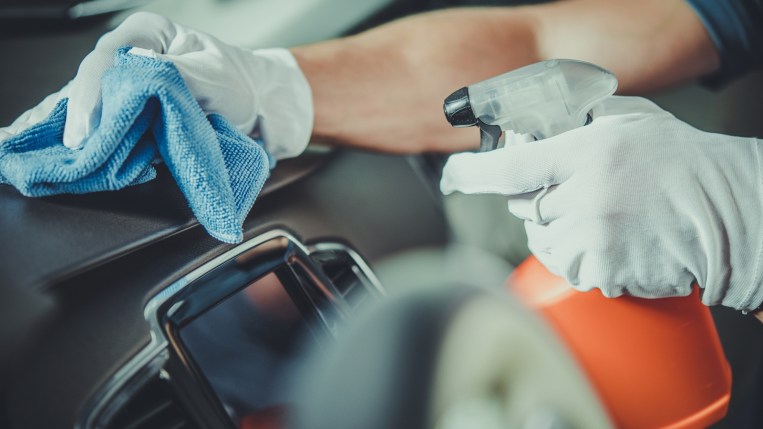
Disinfectant wipes work best in your car or SUV’s cabin. It is the cleaner most used by manufacturers of most automotive interiors today. All it takes is a quick wipe to clean most germs and fingerprints. Soap and water will work, too.
We suggest spending extra time on the steering wheel. According to carrentals.com, a steering wheel can have four times the amount of germs found on an average toilet seat. For this reason, we would suggest using disinfecting wipes to clean all the surfaces on the steering wheel. These include the redundant controls for radio, voice control, cruise control, navigation, and paddle shift levers. And don’t forget about the gear selector lever or the turn indicator stalks.
Also clean the door and center console armrests, display screens, cupholders, cubbyholes, air conditioner vents. Don’t forget the door “grab handles.” You touch them more than you realize and are hot spots for germs including the coronavirus. You will very likely be surprised by the amount of dirt your wipes will pick up.

What not to use

We would advise against using any type of bleach or hydrogen peroxide on the vehicle’s interior. Both chemicals can put a welcome end to the coronavirus, but they will also cause damage to the vinyl and plastics used in most modern vehicles today. Under no circumstances should you use any ammonia-based cleaning products. These can be found in “Blue Glass Cleaners.” (You know which we are talking about.) The ammonia breaks down the vinyl on the dashboard, making it sticky when subjected to heat and light. Additionally, to avoid damage to anti-glare coatings, the glass cleaner should not be used on touch display screens.
Finally, if you find yourself without any disinfectant wipes or other cleaners, a good scrubbing with soap and water can actually rid surfaces of coronavirus and other germs. It just may take a little bit longer to effectively clean it properly. Don’t scrub too hard, though, as you might find you are removing some of the surface coatings or dyes.

Wash your hands, often

Finally, we cannot say this enough: Clean your hands regularly. Even after cleaning your vehicle properly, if your hands are dirty, you are putting germs right back onto an already clean surface.
These tips and bits of car cleaning advice will help keep your vehicle more germ-free than if you left it to fend for itself. No amount of cleaning can guarantee you’ll avoid catching a bug, but these suggestions help to minimize the risk. The added bonus is that your car will enjoy its new status as a clean machine.

Thursday, March 12, 2020

Cleaning Products That Destroy Coronavirus

These Common Household Products 

Can Destroy the Novel Coronavirus

Consumer Reports shows you how to use them and tells you which products to stay away from


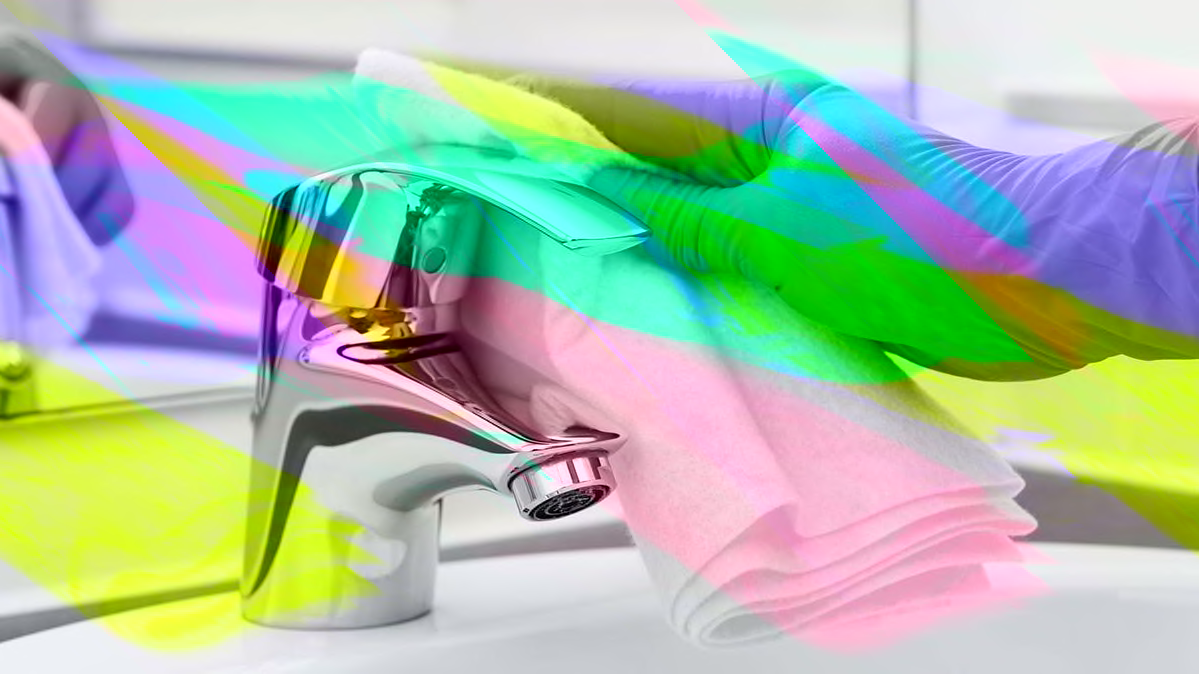
A gloved hand using a disinfectant wipe to clean a faucet.