Thursday, September 22, 2016

For Smarter Healthcare, Ask Your Doctor These 5 Questions


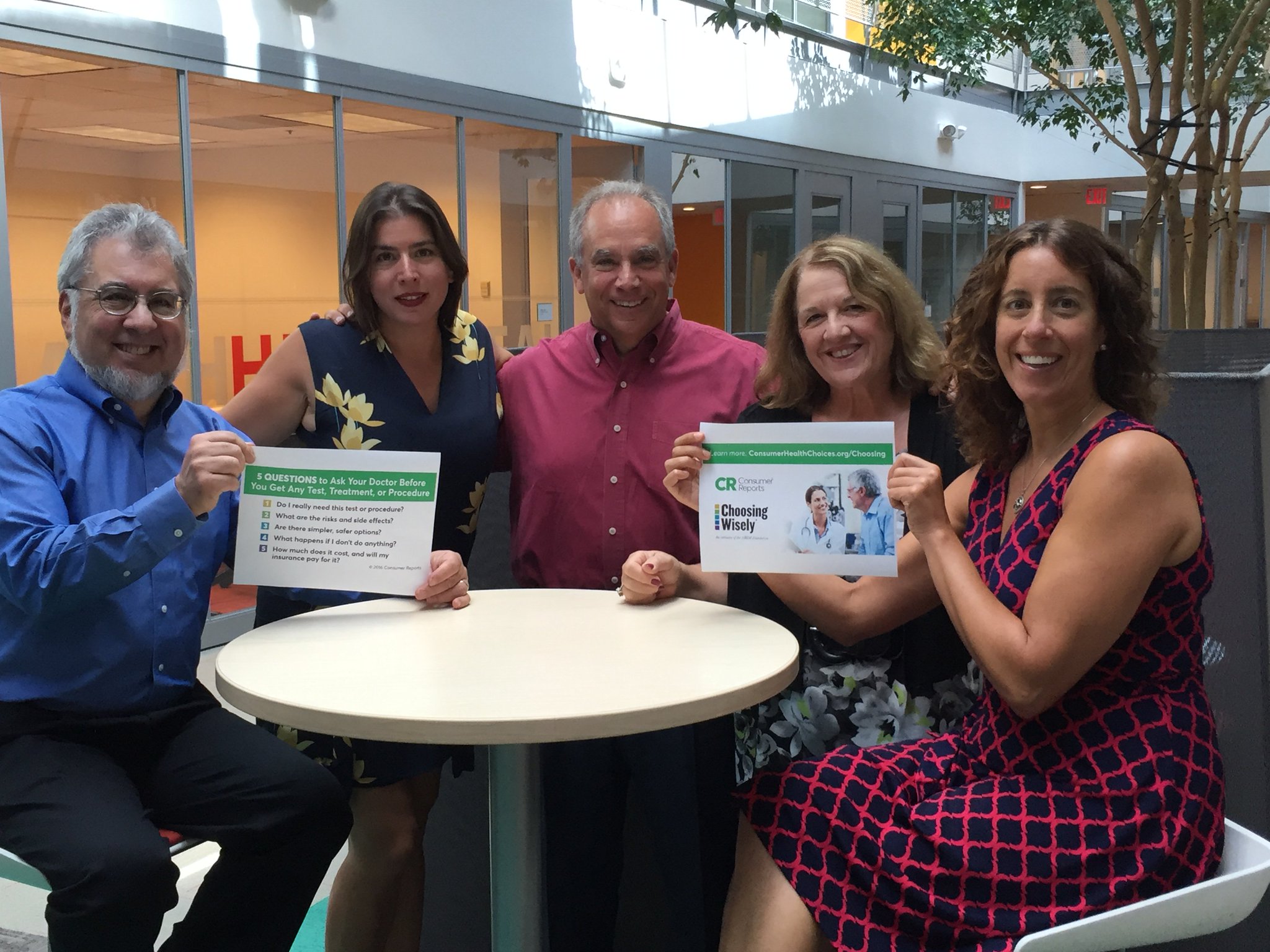
The team here at CR wants to remind you to always ask the 5 questions!


These question can help you avoid unnecessary tests, medications, and procedures.

Before you get any test or treatment, ask your doctor these five questions. Why? Because some medical tests, medications, and procedures may not be right for you. A conversation with your doctor helps you avoid unnecessary, duplicative, or overly risky care.

What to Ask

  1. Do I really need this test or procedure?
  2. What are the risks and side effects?
  3. Are there simpler, safer options?
  4. What happens if I don't do anything?
  5. How much does it cost, and will my insurance pay for it?

One Family's Story About Asking Questions

When Randi O. brought her 79-year-old father to the emergency room, fearing that he had suffered a stroke, it led to an important discovery: Don't be afraid to ask the hard questions. 

We'll Send You a Copy

To get a free copy of the 5 Questions to Ask Your Doctor wallet card, send an email to healthimpact@cr.consumer.org with your name and address.

More About Choosing Wisely

For details about needed (and unneeded) care in more than 100 situations, here is more information about the Choosing Wisely campaign. 

Join Our Campaign

To support our social media campaign, email a selfie you've taken of yourself with the wallet card. Send it to healthimpact@cr.consumer.org.


Monday, September 19, 2016

Is It Too Soon to Get the Flu Vaccine?

Costco, CVS, and Walgreens have started advertising the flu vaccine in the summer months, but for some, it might pay to wait before you vaccinate

Drug store flu vaccine ad.


Consumer Reports / Julia Calderone / September 09, 2016

If you’ve visited your local Costco, CVS, Walgreens, or other stores recently, you might have noticed advertisements for this year's flu vaccines.
Is it a good idea to get the shot now, before flu arrives? Or will that undermine its effectiveness in January and February, when flu season is in full swing?
The Centers for Disease Control and Prevention recommend that most people get vaccinated as soon as the shot becomes available (which can be as early as late July). That way, you’ll be protected when flu season typically starts around mid-October, and when it peaks from December through February. 
Early vaccination is an especially good idea for children six months to 8 years old because, unlike the rest of us, they need two doses of the flu vaccine given 28 days apart, says William Schaffner, M.D., a professor of medicine at Vanderbilt University School of Medicine and a consultant to the CDC’s Advisory Committee on Immunization Practices. So if they get their first shot in early September and their second in early October, they’ll likely be protected by the time the flu arrives.
On the the other hand, two groups of people might benefit from waiting a little bit before getting the shot: people 60 and older and those who have a compromised immune system due to conditions such asautoimmune disease, HIV, or those undergoing chemotherapy treatment.
That’s because in those people, research suggests there’s about a four-month window after getting the vaccine when the body is best able to fight the virus. 
After that, for at least some people in those groups, the immune system’s virus-fighting ability begins to wane.
Schaffner emphasizes that this evidence is not definitive, and that even with declining protection the flu vaccine still seems to provide some protection after four months. Still, he says, people who are older or have underlying chronic diseases might want to wait until late September or early October to be sure that their protection will cover the entire influenza season, which can extend into March, or even dribble into early April.
It doesn't matter whether you get the flu vaccine from your primary care doctor or your local pharmacy, Schaffner says. They’re both perfectly safe places to get it. The most important thing is that you get it. 

Wednesday, September 14, 2016

FDA Finally Says 'No' to Antibacterial Soaps

Antibacterial soap like this one have been banned by the FDA

Consumer Reports / Lauren Cooper / September 02, 2016

Here's why—and the products to watch out for

The Food and Drug Administration is banning the sale of antibacterial soaps and body washes after manufacturers failed to prove that the products’ active ingredients are safe and effective.
“Consumers may think antibacterial washes are more effective at preventing the spread of germs, but we have no scientific evidence that they are any better than plain soap and water,” said Janet Woodcock, M.D., director of the FDA’s Center for Drug Evaluation and Research. “In fact, some data suggests that antibacterial ingredients may do more harm than good over the long term.”
The ban applies to products containing 19 antibacterial ingredients, including the two most common ones: triclosan, which is found in liquid soaps, and triclocarban, found in bar soaps. Manufacturers have until Sept. 6, 2017 to either reformulate products with any of those 19 ingredients or remove them from the market.  
The ban does not apply to other products containing those ingredients, including toothpastes and cleaning products. And it doesn't apply to antiseptic hand cleaners such as Germ-X and Purell, which typically contain alcohol and related compounds and don't pose the same risks.

The Dangers

Consumer Reports has long argued that antibacterial chemicals in household products likely do more harm than good.
“These chemicals could be contributing to the global crisis of antibiotic resistance," said Michael Hansen, Ph.D, senior staff scientist at Consumer Reports.
Triclosan, for example, kills bacteria in much the same way as an antibiotic, and research suggests that the widespread use of it might be contributing to the spread of antibiotic-resistant bacteria.
“Some bacteria are close to evolving resistance to all antibiotics as a result of the overuse of antibiotics—a dangerous situation that could lead to deaths from once easily treated infections,” Hansen said. "These products and these ingredients may just make the problem worse."
Antibacterial compounds in consumer cleaning products might pose other health risks, too.
“There is evidence that exposure to triclosan interferes with the production and activity of hormones in the body, which could contribute to infertility, early puberty, obesity, and other problems,” said Marvin M. Lipman, M.D., Consumer Reports chief medical advisor.
“And with little evidence that they are more effective than soap and water, they are not worth the risk,” Lipman said. “When it comes to fighting disease, hand washing is key, but using regular soap and water does the job," he said.
When soap and water are not available, an alcohol-based hand sanitizer such as Germ-X and Purell is OK. (Click on www.consumerreports.org/health/fda-says-no-antibacterial-soap to watch the video on the most effective hand washing technique.) 

Products to Avoid

Manufacturers have a full year to reformulate or remove their antibacterial soaps, and they can continue to sell antibacterial toothpastes and cleaners. But Consumer Reports health and safety experts say you should avoid them, starting now.
We found triclosan listed as an ingredient in Noxzema Ultimate Clear Bacteria Fighting Cleanser, Dial Complete Antibacterial Foaming Hand Wash, and CVS Antibacterial Gentle Cleansing bar, as well as in Colgate Total toothpaste. And we found triclocarban listed on Dial For Men Power Scrub soap bar, Rite Aid Renewal Antibacterial Gold deodorant soap, and others.
Those and other banned antibacterial ingredients are also included in many household cleaners. So avoid products that have an "antibacterial" claim on their label, or that contain any of these newly banned chemicals:
  • Cloflucarban
  • Fluorosalan
  • Hexachlorophene
  • Hexylresorcinol
  • Iodine complex (ammonium ether sulfate and polyoxyethylene sorbitan monolaurate)
  • Iodine complex (phosphate ester of alkylaryloxy polyethylene glycol)
  • Nonylphenoxypoly (ethyleneoxy) ethanoliodine
  • Poloxamer-iodine complex
  • Povidone-iodine 5 to 10 percent
  • Undecoylium chloride iodine complex
  • Methylbenzethonium chloride
  • Phenol (greater than 1.5 percent)
  • Phenol (less than 1.5 percent)
  • Secondary amyltricresols
  • Sodium oxychlorosene
  • Tribromsalan
  • Triclocarban
  • Triclosan
  • Triple dye

Thursday, September 8, 2016

Consumers Union Urges FTC to Investigate Mylan for Possible Antitrust Violations

Reprinted from CONSUMERS UNION
POLICY & ACTION FROM CONSUMER REPORTS
www.consumersunion.org
Wednesday, September 7, 2016

WASHINGTON, DC – Consumers Union, the policy and mobilization arm of Consumer Reports, today sent a letter urging the FTC to investigate Mylan for possible anti-competitive practices and antitrust law violations, noting troubling reports of Mylan’s efforts to undercut EpiPen competitors and suppress consumer choice.

Consumers Union describes the five-fold price hike of EpiPen as a “calculated decision by Mylan to exploit its monopoly power to enrich itself and its executives at the expense of the millions of consumers who use this life-saving drug and delivery system as a failsafe,” after a review of the situation produced no legitimate justification for the rapid price hikes. While the letter notes that taking advantage of a marketplace monopoly does not, by itself, violate antitrust laws, the consumer group calls into question several examples of Mylan potentially running afoul of the law.

“It is a violation for a company to maintain its monopoly power by sabotaging or undercutting efforts by competitors to give consumers a choice,” said George Slover, senior policy counsel for Consumers Union. “There are indications that Mylan may have resorted to questionable practices to block competition and sustain its monopoly. The FTC has the authority to prosecute anticompetitive marketplace abuses and we urge the Commission to thoroughly investigate and take appropriate action based on what it uncovers.”

New York Attorney General Eric Schneiderman yesterday announced an investigation into Mylan’s practices and Senators Klobuchar and Blumenthal have also called on the FTC to investigate the company’s conduct.

Visit ConsumersUnion.org to read the full letter.

Consumers Union is the policy and mobilization arm of Consumer Reports.  Consumers Union works for health reform, food and product safety, financial reform, and other consumer issues in Washington, D.C., the states, and in the marketplace. Consumer Reports is the world’s largest independent product-testing organization.  Using its more than 50 labs, auto test center, and survey research center, the nonprofit rates thousands of products and services annually.  Founded in 1936, Consumer Reports has over 8 million subscribers to its magazine, website, and other publications.